Insurance, Universal Health, and BS (slight repeat)

I would not be the first one to point out that this is the way things are. Hospital bills are insanely high. The birthing of my child including the subsequent 11 days of hospital NICU (neonatal intensive care unit) stay at the Stanford Lucile Packard Children Hospital resulted in a combined bill for both mom and child of $157k. And let me say upfront the staff at LPCH worked very hard to make our stay comfortable. We learned a lot about taking care of the baby there from all the wonderful nurses and Dr.’s

$175k is a lot of money: With that money I could three(3) base Model S’s. Or I could pay off of some of my mortgage. Or pay off my parent’s mortgage. At my planned saving rate of about $20k a year, it would take me 8.5 years to accumulate that amount of money, just for a single incident of child-birth(not including continuing costs after the fact). Now, being an informed modern man, I appreciate the 99.99%(estimated) success rate of child-birth that this cost buys me. And indeed my child is healthy and alive, and she may very well not be if we had her in a wilder situation where the cost is less. The peace of mind that we have knowing that there is a machine and two nurses watching over the child during those tenuous times is very much worth it.

Now there are two issues of concern. One of them is that the entire process was not 100% pleasant, there were times when we wondered if the doctors/nurses/staff were picking on us because of our minority status or apparent lack of wealth or influence. Some staff were quite obnoxious, one even dropped his badge in an inconspicuous place in order to lift my wife’s cover to search for it. what a pervert!

Anyway, that’s not the problem. This $175k bill would have put me in debt for 8.5 years if I did not have an insurance. The insurance company negotiated a different price tier and then paid for about 95% of the negotiated fees to the LPCH. Without insurance company, I may have simply taken the child home after birth and watched her stop breathing and then eventually rush her body to the hospital. Without insurance, my wife would suffer from untreated back injury from the birthing process. Without insurance, I would not be able to take the baby to a dr. about the mucky eyes she has and eating/pooping/peeing issues and various growths and spots and all kinds of weird alien things baby produce. Life would not be life as I know it without the group comprehensive insurance provided by my employer.

Recalling just a mere 6 months prior to this, I was rejected for insurance by a large PPO because I checked a box that said I snored–due to a prior condition. I am a fairly healthy person in my mid 30’s and being rejected for health insurance was the last thing I expected… it kind of ended my consulting career.

Let’s think of health insurance in more detail. Insurance is a benefit, part of my compensation package, my employee give me for my service to the company. What this means is that I must work for an employee that provides group insurance in order to continue to receive this kind of benefit.

It would seem that the pressure and flow of money is as follows: medical cost is high, insanely high, to a point that it would appear an uninsured person cannot pay for basic care. Each individual is highly incentivized to work for large corporations that provide group health insurance, because if they don’t they cannot get health coverage and because the cost of health care is high, they cannot get health care. (oh, and also in the same breath, only spouse of a heterosexual marriage can benefit under group health insurance)

I personally appreciate the role of doctors play in society. They use their life’s time and energy to become good at treating people’s illnesses so that other people can live long and happy lives. I think the medical-industrial-complex that power advanced research in science and technology that produce advanced diagnostic tools (xray,mri, etc.) and drugs, and genetic therapy, and stem cell research, all these things trying to make people’s life better are great! It costs a lot of money and require a lot of resources: universities, hospitals, buildings, power/computing infrastructure, lots of smart people to achieve advancement. So an expensive drug, expensive test, if charged by original developer, is cost to pay for past and future research. Expensive doctor is to pay for his educational cost and to maintain his alertness, dedication to the unbiased professional medical treatment of his patients. I want them to make more money because I don’t want to have to wonder if my Jewish doctor treat Jewish children better than my child or if my Russian doctor treat his Russian patients differently from my wife. I want to receive good treatment and I believe that most doctors are paid above other people not only because of their unique skill sets but also because they rise above all that, ethically, and heal their patients any human patients to health.

BUT, that fact is being exploited by large corporations. Only large corporations can afford group health insurance. Therefore only they have access to people who want health care. Fundamentally, there is nothing wrong with this. But practically it forces all health-conscious people to subscribe to corporate culture. We do not have a choice in how we contribute to society, but as long as we want to see a doctor when we need, we must be part of a large organization full-time.

Some additional aspects of this arrangement: If I had a serious prior condition that requires constant treatment, then I must be employed at a large company in order to survive with life. If there are any bias in corporate employment then the same bias would occur in availability of medical treatment. If I stop working or have never had insurance, I must work for a company because I will not be able to get insurance having a break in health coverage. I cannot leave the company for injustice or corruption immediately and in the duration of dispute, I may not be able to continue with insurance, and the interruption in coverage will result in the impossibility of my getting health insurance.

I have always been in favor of universal health care in America. This is not because I come from a faux-social/communist China. I am in favor of universal health care despite the fact that the medical super industry will not receive as much money from patients because the US government will surely negotiate an even better price than the private insurance companies. I am in favor of universal health care–for basic maintenance care–because health, along with wealth, is part of our pursuit of happiness. I do not believe one can be happy secured with his wealth but insecure with his health, and we should have the freedom to choose health independent of wealth. Health is life. Right of life means right of health, protection for right of life means protection for right of health–in fact protection to right of health should be on par with the right to secure one’s wealth. Health is happiness. Pursuit of happiness requires health. This is why I think universal health care–to a certain level–is a must. Even if it detracts slightly from advanced medical research.

Okay, moving on. A thought occur to me the other day on the way home from my health-coverage earning job in corporate America. I thought of the transitive action space(TAS) more. The TAS encodes actions between people, therefore should be thought of as only encompassing all endeavors regarding acting morally. Again, I justify this because the original thread of thought came form the golden and silver rules of ethics both of which directs us in how to act.

But clearly they have said more than that, for instance it has been said that one should “love thy neighbor as thy self.” Granted this a command in the TAS, but more action this is a feeling. Love is a feeling, is a state of mind that can occur without visible action in the TAS. Perhaps we should also mention the existence of transitive emotional space, TES. Subsets of TES instructs us about the moral ways to feel–whether we have control over feelings, and are they moral if we control the feeling rather than naturally feel, is an entirely different discussion. We can, in fact, specify the subspace of TES that is moral, the Bible sure does.

There are of course yet other instructions in morality that instructs us on how to “be”. “Be one with God,” “Be one with the universe,” “Being a higher being,” “Being enlightened”… and so on and so forth. Some argue that the being is creating an internal state, and therefore being moral is the moral motive force that enable us to act and feel morally. Some even stipulate that without a moral motive force a moral space in TAS is not moral. For instance, if I feed my baby with an intent driven by the perverted curiosity of seeing a grossly obese 1yr old, then the action of “feeding a baby” in TAS is entirely moral (possibly universally), but the being inside BS is immoral. Most would agree that the act is entirely immoral.

Therefore we should also seriously consider BS–Being Space that contain all the ways that we could be. The challenge of such a space is that BS is of much higher cardinality than TAS. In the real world, we can very likely specify countable discrete TAS for a certain self contained situation in which we have to make moral choices, where as I am not able to imagine the “enlightened” and “universe” beingness of BS–do they intersect? does one contain the other? What are the sets in TAS that corresponds to their intersections? Does intersection and containment make sense in the BS? How do I choice to be something BS? How do I be something in the BS?

Ultimately, the choice of TAS seem rightous at this stage of my investigation. And I beleive that even if BS is ultimately the only space where morality is true, that there is a TAS projection from BS that can be modeled. From time to time, we may need to point out the relation between a TAS set and BS but until I have the language to discuss it, BS shall remain mysterious and unexplained.


Code.org Advertisement and no-WFH

Recently code.org publicized a promotional video featuring ppl like Mark Zuckerberg of Facebook and Bill Gates of Micro$oft saying American schools should teach programming more.


I don’t like it.


I don’t think programming is for everyone and that more programming is for social good or scientific advancement. It lowers cost of labor for all those people in the Advertisement, but it isn’t as good as it sounds.


As a person who completed a CS degree, I feel that computer language can be made much better so that there won’t be a “computer programming”


The day that I tried to teach my dad to program a for-loop in C and he turned around and teased me about forgetting the closed form expression for arithmetic series was the first time that I thought about how stupid this stuff I do is. It was the expression on my dad’s face… I remember it vividly… For it was then that I realize that I did not comprehend the sheer vulgarity of

for(int x=0;x<100;++x);

so primitive, so stupid.

The next time is when I read about Map-Reduce–sooo freaking cool. I think tomorrow I will find another way to think, another way to say, and another way to program.


I want to make a better programming language. a better computer. That would be better than community colleges teaching Fortran IMHO


Oh, and p.s.

I think Yahoo!’s new no-policy is nice. I think is real progress for protection of civil liberty in America. Technology companies insists on ownership and monitoring of its employees while working, and admittedly justified to do so. Therefore when Marissa Mayers decided to cancel all WFH, she made a call that will end monitoring of employees’ home networks–because if you don’t work from home, the company will have no cause to instrument any kind of monitoring of your home network.

I think this is a really forward thinking technology leader who care about her employees. I am buying myself some Yahoo! stocks in support of this bold move.

The Ethical Hiearchy III

Recall, from last time, this illustration of the Ethics Hierarchy overlaying capability sets in the space of all transitive actions:

gold versus silver 1

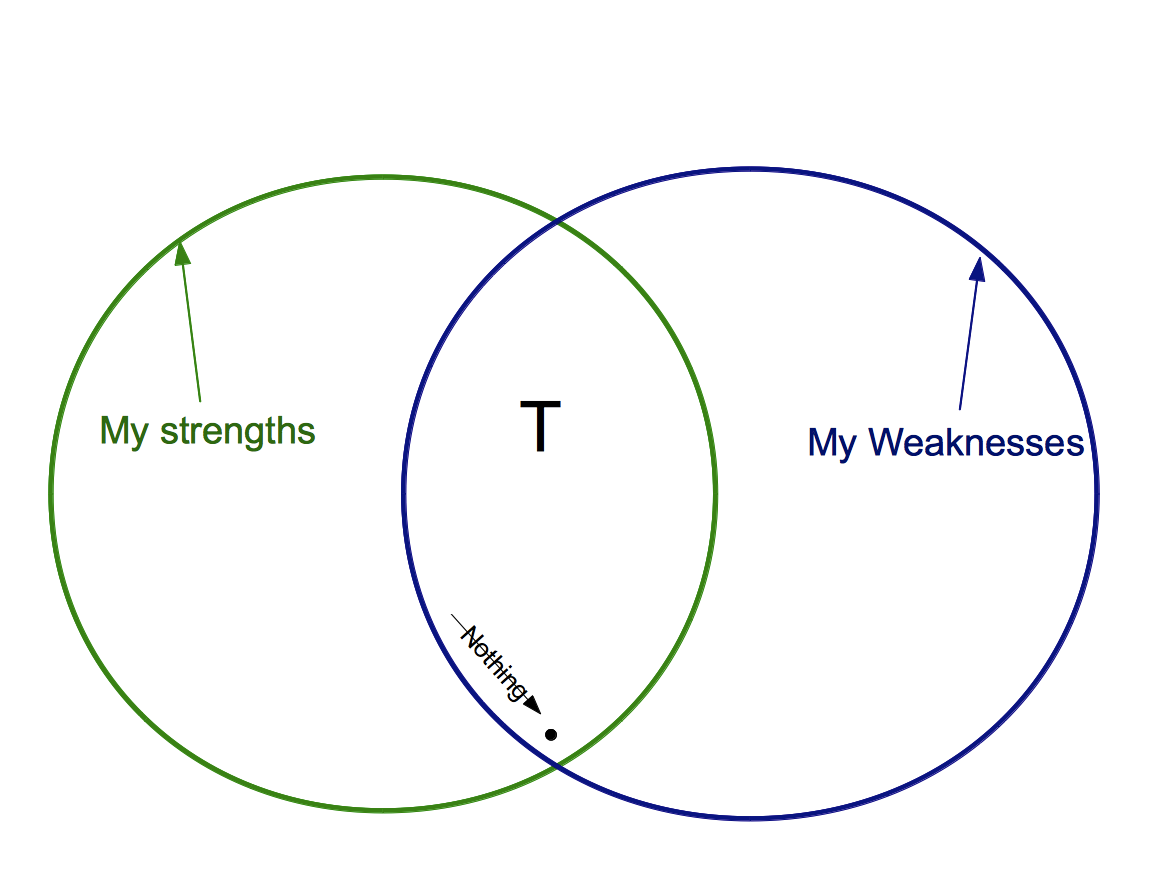
I should simplify terminology. The set labeled “Things I want” are “my desires”, “things Jesus wants me to do” is the Jesus way, “Things Confucius wants me to do” the Confucian way, “Things I can do” are “my strengths” and “Things can be done to me” are “my weaknesses”.


I should also like to begin referring to what I have been calling the Ethics Hierarchy as the Moral Hierarchy. My own postings exhibit cultural bias. I include more from eastern culture than western culture. Some comments I have received indicate that there are others out there who have looked at culture/art/literature comparisons with the opposite bias. The fact of matter is, this Moral Hierarchy itself does not imply absolute superiority of any kind. Relatively speaking, one is larger, contains more transitive actions, than the other, but bigger is not necessarily better. In fact, it is one of my hopes to understand how they are different. Reasonably speaking, I should not expect to find that one is superior to the other–quite the opposite, I feel that exhaustive investigation of this subject will reveal to us more about the way the world, humans, and our society are than about the rights and wrongs within their contexts. Because morals have cultural biases and ethics is the philosophical study of morals, I may switch back to Ethics Hierarchy when I wish to emphasize that I am trying to be objective.


Therefore, to continue, let us be fair, what is drawn are idealized sets and intersections. The Jesus way is actually one of many allowed sets of actions that has an inner-bound restriction of being bigger than the my desires. Under this prescription alone, one can do everything in the universe and still not violate the Golden rule. The Confucius set, similarly is one of many possible sets fully contained in my wants set. The Silver rule has a maximum outer bound, one can only do things within my wants. Under silver rule, one cannot do everything in the world.


Some extreme examples might be, for instance, a person that goes around slaughtering each person with a knife is allowed under one interpretation of the Jesus way, as long as he also does everything that he wants for that person. This can be quite arbitrary, say, the perpetrator wants to be fed carrot cake, then he feed everyone carrot cake and then knifes them. What’s worse is if the person is masochist, then he is forced to act as sadomasochist. If he wants to be fed carrot cake and knifed, then Jesus way requires that he _must_ both feed everyone carrot cake and knife them.


On the other extreme, suppose one tries to follow Taoist suggestion to do nothing, it easily fall within Confucian way without regard to the size of my desires. While the only way for a person to do only nothing under the Jesus way is for him to want nothing. This is impossible because follower of the ways of Jesus at least want to enter heaven, so trivially Jesus way is never empty and prevents follower from doing nothing.


It’s interesting to think of the possibilities. Let’s look at just the Confucian way. Set D is outside of my strengths, and it is outside of my weaknesses, however, because I desire it, it is within the Confucian way. Set A are things I desire, within my strength to do and outside of my weakness to receive. These are the things that I can only give and will never receive in kind. On the opposite end, set C are within my desires and weaknesses but not within my strengths. O is the set of my opportunities–these are the things I want but am not yet capable of receiving. Set B is a sweet spot. Here, not only are we within the ways of both Confucius and Jesus, we also desire to do so. This is a region to maximize, if we had the choice to do so.


gold versus silver 3


It should be pointed out that zone B contains only actions that we can reciprocate when receiving and receive reciprocation when giving–in kind–in other words, an eye for an eye, a tooth for a tooth zone.


Zone U in this graph points out an area of the an-eye-for-an-eye-a-tooth-for-a-tooth zone that is outside of my own desire and therefore not recommended by either Confucius, but is allowable by the Jesus way.


Let’s backtrack and admire the an-eye-for-an-eye-a-tooth-for-a-tooth zone T in its full glory


gold versus silver 2


Wow! It does exists!

With Higher Knowledge Come Higher Responsibility

The other day, at work, (and by now you know I work for a Japanese Automotive Electronics company), we talked about autonomous cars for consumes. Since everyone is either technology freak or car freak the discussion was pretty intense.


I explained to every one the ethical issue surrounding autonomous cars that may be not be completely resolved or resolvable by technology.


The matter is this: an autonomous car will with absolute certainty be faced with a situation where it has to choose between two actions each will be killing a different person. Suppose two person suddenly dash in front of the car to the left and to the right, and suppose that the car is moving too fast to stop. it can veer to avoid one person with certainty. But which will it choose?


Another scenario: the car can brake very hard and avoid killing a pedestrian, but in the process it will have killed the passenger because the car is mechanically able to endure much higher de-acceleration than its occupants.


The legal problem also, if I configure the car, or if some car company configure the car to always protect its owner (rational), that I the owner, the designer, the manufacturer is then liable to be sued for killing people?


“But your honor, the car swerved!! I had nothing to do with it”


Okay, so the people who want autonomous cars (myself partially included), will say that with better equipment, high-speed video/audio recording and black-boxes, there might be far fewer arguments about who was responsible for accidents. But there are some things in our current law that are absolute. If a car hits a person inside the cross walk, the car is always responsible. If the car is rear-ended the car in arrear will be responsible. What will happen to these absolute laws that are in many circumstances unreasonable but serve to protect the safety of the population?


And finally, even if, and I believe it will, autonomous vehicles reduce death to 1% or less of today’s vehicle related death rate, that 1% where two person dash in front of the car, and the car has to choose, what then? Why is this so hard?


One of the big problems is informed decision is hard. The car, given today’s technology, machine learning technology for object detection, vision algorithms, radar, laser range scanner, eeg/ekg, EMR technologies can pretty reliably detect with plenty of time to choose which one to save, that there are two person dashing infront of the car one to the left, one to the right, velocity, estimated trajectory, mass, the certainty of these estimate and the margins of error (where else could each person likely be by the time we collide, etc.)

The reason human get away with killing in this situation is that we do not have the speed and ability. It is beyond our control–until we programmed a computer to do it, and then we are suddenly faced with choice that we never had to make before: kill left, kill right or maim both? or risk killing both? or kill myself to completely avoid  their injury?

Hmm, let’s see, What would Confucius allow? What would Jesus insist? Well, I don’t want to be killed, so don’t kill other people. I would want other people to save me so I would want to brake an save both crazy people. Hmm, I guess it really depends on the person’s desire. One would say a more moral person may not wish for another moral entity to suffer in exchange for his own sake, as well to exchange another’s life for his own. But by and large most people would ask the car to save himself no matter which place he is in.

The moral problem arise in that we are not in any of those three situations. We are in the autonomous car’s designer’s shoes. We are in Asimov’s shoes. What should we write as the laws of autonomous vehicles? When we know that at some point, the car will know almost certainly that it must kill/damage/disrupt someone/thing, and knows exactly which wire to send electric signal down to to choose which person. What should we tell the car to do?

Because soon the car will be looking at that scenario in slow-mo… with 10ms to decide and then 250ms seconds to turn the steering wheel left or right and apply brakes.

So, as you can see, the mere knowledge of morality and capability to choose encumber us with the responsibility of behaving morally. Because I know it’s wrong, I must not do wrong. Another person may think that the root of this evil is the fact that I know of this moral dilemma and that I have gained the speed to travel fast or gained the speed to determine people’s fate.

I wonder if the are right that those things are works of devil and that the absolute best moral thing to do is just to stay away from them? I should consider this carefully. What if I find that it is wrong for me to live? or wrong for me to blog about morality? What if it is found that internet is not moral? or god forbid that it is immoral to have stereo audio in cars? Because I already of the ability to terminate any one of them–at least for myself.


*shiver*


p.s.

I can accept an argument that placing one’s self into a situation where there is no moral choice is immoral. The autonomous car makers will insist that car drive carefully so that it will never be faced with 2 people in said situation. But somehow, science, technology–human inquiry–may find a way to inform us that that is just delusional, that it is provably impossible to avoid crazy human. 😉 back to square-one I suppose.


Chinese Hackers

A carefully choreographed expose by a US security company Mandiant on Chinese military unit 61398 hacking critical US infrastructure hit the news recently

http://techcrunch.com/2013/02/19/video-released-of-shadowy-chinese-army-hacker-unit-in-action/

http://www.scribd.com/doc/126209983/Mandiant-APT1-Report

http://www.washingtonpost.com/business/capitalbusiness/mandiant-in-the-spotlight-as-cyber-attacks-on-companies-increase/2013/02/15/f067cb88-76d0-11e2-8f84-3e4b513b1a13_story.html

http://blogs.wsj.com/corruption-currents/2013/02/19/high-tide-from-unit-61398-to-hollywood-unnerved/

will refrain from writing about how clean the screen capture of remote login sessions of alleged Chines intruders experiment on US computers. I mean, without inflammatory audio, you’d think you were watching a prepared screen-cast of some installation instructions of some software. too clean, too easy to be fake.

I will refrain from writing about how it is unbelievable that the US, inventor and creator of all this technology. All those smart people recruited by Microsoft with money$$$, all those smart people who invented and wrote unixes, the super smart people who work on these best cryptographic algorithms, all those insanely sharp folks who do core networking infrastructure, who have Ph.D.’s and patents and all the fame and much money of the world, all those smart friends of mine who are so insanely intelligent and agile in thinking and comprehensive in technical knowledge–all those people, things, designs which is property of the USA fail to beat “military intelligence” of Chinese origin.

I just cannot believe this. Is there a punch line to this?[[[UPDATE: actually, there is. the punch line was a news drop two days later admitting that they only caught the low-end of Chinese hacking that there are more advanced hackers. Undoubtedly this is a call for blood of Chinese Americans. It is a call for racism and unsupervised pervasive monitoring of all people of Chinese origin. I am of Chinese origin and I know racism when I see it. As a Chinese American I feel threatened. I feel insecure. I feel that there eyes watching me every moment of my life with all neurons firing thinking of all the bad intents I have for America or my company or the economy or “critical infrastructures”]]]

Seriously. if this was real, it would have been from pride of design and ownership. I am sure all those people involved in the design and implementation of compromised systems also had this feeling of invincible American computer technology. For god sakes! it was invented here, designed here, and for the most part implemented on the USA proper.

I just cannot believe this story.

At best, given my current knowledge and believes, this story is a thorough fabrication. And it is not as hard as faking moon landing. I can probably do it, and if I can’t the coworkers who has actually done a remote desktop on MS window server can surely arrange for this to happen. (okay, okay, I didn’t actually go and download the md5 section of the report, perhaps it gives evidence that the session were really from China, I don’t see how tho.)

I will also refrain from writing about the lack of properly trained security professionals in the US. There some professional training in computer security, for example by the SCPD(http://scpd.stanford.edu/computerSecurity/), certainly one can obtain a PhD in computer security from the likes of CMU or MIT or Berkley.  I think a better story would have been: Those companies/critical infrastructure not guarded by trained professionals were compromised, but those that were guarded by trained experts were safe. If it was fake–and I think it was–Generating a large unknown enemy creates uncertainty that may crash the stock market or ruin the economy where as spreading positive message about serious organized effort promotes solidarity and confidence.

I will also refrain from writing about the main motivation for creating such stories: If China, a military state is doing all this shit to America then we need give more power to the US military to respond, to defend–it is a call for increase in defense budget. It is a call for even more powerful version of the de facto at-will monitoring policy–to mandatory monitoring policy.

I will also refrain from mentioning illegality of entrapment. given the amount of monitoring and manipulation of network that occur at my work place where I am there in person, and you know what I’m talking about, you will surely be giggling at this story about remote intrusion–it is impossible unless somebody not only opened/installed/designed the security holes and then leaked it to the Chinese.

crap! crap! this is total crap!

Also, wtf is up with China? Why not respond, in addition to “We don’t hack” with “And we will investigate this certain unit 61398” ? The civilian government(who is trying to strength Sino-US relationship and building the “Made In China” brand) should have the curiosity about this fact if it was happening autonomously. Would it not be better for it to discover a corrupt unit of the military and punish them? The Chinese loves reform and publication of corruption, it would make story that the US will have to respond to.

Alas, I am not the screen writer for the world of international hackery show.

Oh, hehehe, if the Chinese police show up at that building, surround it with choppers and tanks only to find a bunch of teenager subcontractors clicking on google ads. hahahahha and it gets caught on cell phone video and is leaked to youtube.. that would be a real hoot! hahahah the irony.

The problem with Transitivity II–Unfixing Trivalency

Looking at my old blog entries, I think there is a problem with our earlier attempt at addressing tri-transitivity and higher order valences. The problem actually points to a larger issue. Let us try an extended example of trivalency

I am giving you a slave named Tom.

Subject: I

Object: you

Object being done with: A slave named Tom

Thinking of ethical issues: My giving a slave may be considered wrong and you allowing a slave to be given to you my be considered immoral. But ultimately, that Tom is a slave is perhaps something not ethical in and of himself. What about

I am giving you a slave named Tom to keep you alive from being quadriplegic and demented.

This seem to make me a good person and give you just cause to require full time service of a devoted person. Is this act allowable? I would if I followed Jesus’s way, and I could if I followed Confucian way.

What about the veil of innocence, how come it isn’t compatible here? at first glance, it seems that it should, what if you were Tom and you were being given. You would then choose not to give tom as slave right? But in Bi-transitive Action Space, let’s call it BTAS for short, we have no way of evaluating that, you are either subject or object, there is no third position.

The reasoning here, therefore, must extend analysis of Tri-Transitive Action Space, TTAS, and other higher valencies, HTAS’s,  to analyze the TAS itself for inclusion and usage of ethical entities that are considered of same importance as the subject and objects of TAS analysis.

* Giving a person as slave is unethical.

* Using a person as a slave is unethical.

* Being used as a slave is unethical.

The first two come from a traditional ethical systems. One cannot use another ethical entity in a subjugated manor, and one should not force an ethical entity into such a position. But what about the third, that seems a little stranger, allowing oneself to be enslaved is an unethical act. Certainly an ethical entity may be able to enslave another and should do that instead of being enslaved. Alas, these problems are indeed at the heart of concerns driving these current carpal tunnel stiffened hands into worse states than they are in already. At least, our action space needs to give us the ability to consider the third ethical entity.

Let us be more specific about BTAS as well, it is really very easy to include HTAS inside BTAS. So we need a class of TAS that include exclusively Bi-transitive verbs where the verb themselves do not use or influence any other entities affecting ethical value. This class of actions we shall refer to as Full-Bi-Transitive Action Space, or FBTAS(ef-bee-taz) for short. And similarly FTTAS for tri-transitive verbs with clearly distinguishable subject, object, and third thing which the action uses and affects evaluations of ethical nature.

I fear soon we will run out of letters and theory synonyms as we look into this matter deeply. I am driven to think of another way to think about this issue… Naming a new space for different situations is too troublesome and impractical.

IG and the Quantification of Privacy

A while back, I talked about computing IG–information gain–by clandestine methods via an otherwise secret(personal) email. I will point to some other prior blogs entries about what can we reasonably consider private and some reasons why I think it’s bad (Because it removes competition….

The basic challenge is this: If your competitor can spy on what you do (unilaterally) then they will never be motivated to innovate. Their key strength will be their ability to hack your secrets and they will work hard on that, but not on how to build a better product or cure a disease or solve a new problem. If you can both spy on each other with perfect information then there is no need to innovate, just calculate the equilibrium and aim for that. If you can disinform your opponent then all your effort will go into disinformation instead of innovation. Basically it is much easier to do something sneaky and cheat than to do the right thing and innovate. This is why the government, a non-competing body whose interest is to make sure everyone compete (at least in America government this is the case), should provide for information security.

)

I realize in retrospect that IG may not make sense to most people based on the formulation I laid out. Let’s review. IG is the change in entropy from a state without additional knowledge to a state with knowledge

IG = H(secret) – H(secret | private email)

This measurement seem to be of a quite abstract concept of entropy–a unitless measurement. Why would I think this useful for any reason other than that it is called “Information Gain?” Well truth be told, what I had in mind was more of the IG from machine learning literature: Class purity after conditioning on some private information. It is actually used more as a measurement of correctness of predicting discrete output than abstract change in entropy of distribution after conditioning. I will refer reader to these excellent introductory books regarding “classification” algorithms.

… Some days passes and the books will hopefully have arrived on your desks…

So the example is if my secret is the probability that I will have Chinese food tonight. Let’s throw in several more classes, say Italian, Mexican cover 99.9% of all possibilities. This probability may be internal to me. Or it may be an externalizable model like I will toss a three-sided die and figure out what I will eat tonight.

Actually, this system forces us to think of a new class. I will call this new class the innovation class. It covers all cases where something new might happen, such as tonight when I went off on a tangent and forgot to eat dinner completely. Or I might be abducted by Aliens for demanding privacy, Japanese paramilitary for blogging, or God for thinking all these awful things. The fact is, I do not know what will happen, but what I do know is that things I don’t know will happen. So the class is called IC, Innovation Class–now we have a 4 sided die: Chinese, Mexican, Italian, IC; Let’s write naively that the probability for each class is:

Chinese Mexican Italian IC
33% 33% 33% 1%

The formula for the entropy of these classes is written as:

-H(Dinner)= p(Chinese) * log(p(Chinese)) + p(Mexican) * log(p(Mexican)) + p(Italian) * log(p(Italian)) + p(IC)*log(p(IC))

the above evaluates to almost the maximum possible entropy in three-class situation: H(Dinner)= 1.6499060116098556

that’s it. that’s the formula for calculating entropy that we will use repeatedly. Now, suppose that you have read my email to my wife saying “oh man, look at this great deal on groupon, 50% off on Indian food right near our home” What is the right thing to think about the distribution of my dinner?

P(IC)=99%

Indian food is not Chinese or Mexican or Italian, but we have thought of that and put in IC to account for it.

Chinese Mexican Italian IC
10% 10% 10% 70%

-H(Dinner|private email to wife) = p(Chinese|private email to wife) * log(p(Chinese|private email to wife)) + p(Mexican|private email to wife) * log(p(Mexican|private email to wife)) + p(Italian|private email to wife) * log(p(Italian|private email to wife)) + p(IC|private email to wife)*log(p(IC|private email to wife))

gives us the conditional entropy of probability of dinner after reading my private email. This entropy H(Dinner|private email to wife)=0.09596342477405478

IG(Dinner; private email to wife) = H(Dinner) – H(Dinner|private email to wife) = 1.6499060116098556-0.09596342477405478=1.5539425868358008. This corresponds to an IGR of 1619.31%, that is, 15X more information after you saw the email than before.


Great! so now we know how much information is gained by reading that one private email of mine. This number, I think quantifies my loss of privacy.


Btw, this innocent example contain some hand waving. H(Dinner) for example is something that we may or may not know. Most people have trouble writing down a distribution for dinner choices. also, P(Dinner|private email to wife) here written as a table contain assumed values. What if after reading my private email you feel that P(IC)=85%? Who is to say what the reality of this probability is? This is why I felt that this model will not make to main stream legal system because the link between private email and the actual secret itself is not so obvious. You might use naive Bayes as the definitive of reality (refer to chapter in books or wiki), logistic regression, decision trees, or you might use something else… You may even use a distributions system like SVM or god forbid rule based systems…

If you understand this computation above, then it will be easy for you to understand the continuous version. Let dinner be a continuous variable, we can still write the same expression

IG(Dinner; private email to wife) = H(Dinner) – H(Dinner|private email to wife)

and it would have the same meaning. How far are we from the truth. This idea, btw, is indeed partially inspired by the name Information Gain, which also goes by Kullback-Leibler divergence when computed over distributions. The above formation exactly with the exception that “private email to wife” is a distribution, say, perhaps, my emails are generated randomly.

KL( Dinner|private email || Dinner )

But KL divergence does point us to some other interesting characterizations. Divergence–distance without some properties of distance. Namely that it is not a metric distance:

* Nonnegative dl(x,y)>=0:  yes

* Indiscernability: dl(x,y)=0 iff x==y: yes

* Symmetric dl(x,y)==dl(y,x): NO

* Triangle inequality dl(x,y)+dl(y,z) >= dl(x,z): NO

This has some serious implications regarding this formulation of privacy. Somethings that we naturally think should make sense do not.

Let’s say I have two emails, e1 and e2, and let’s say dinner is still the subject of intense TLA investigation:

KL(d;e1) + KL(d;e2) != KL(d;e1,e2)

All private information must be considered together, because considering them separately would yield inconsistent measurement of privacy loss

Let’s say there’re two secrets, d1 is my dinner choose and d2 is my wife’s dinner choose

KL(d1;e1,e2) + KL(d2;e1,e2) != KL(d1,d2; e1,e2)

All secrets must be computed together, because computing IG separately and adding is not equal to the total information gain.

Let’s say we have an intermediate decision called Mode of Transportation (mt), and it is a secret just like my dinner choice.

KL(mt;e1,e2) + KL(d ; mt) != KL(d; e1,e 2)

The intermediate secret can be calculated, but again, it must be calculated carefully and not by additive increase of IG.

Bummer, but fascinating!! But we we must make some choice about how to proceed. Knowledge about the nature of information (and especially electronic information), I believe, informs us about how we make choice in our privacy laws:


  • Should the whole data be analyzed all at once?
  • or should we only allow each individual’s data be processed all at once?
  • or should we only allow daily data of everyone to be processed together?
  • or should we only allow daily data  of each individual to be processed separately?

Each of these choice (and many other) impact the private information loss due to clandestine activities.


For Richer and for Poorer

The title makes no reference to marriage, per say. Bear with me here for a sec…

A certain strange set of circumstances inspires this thought. Some time ago, some entrepreneurial friends recommends a series of books to me, How to Win Friends and Influence people and Rich Dad, Poor Dad. Saying that these are must read for a young person planning to have a good life.


And I’ve never read either, btw, I’m guessing it really shows, huh?


Okay, okay, please stay calm when I say this, and hopefully you find it funny and non-offensive, as I don’t want my tires punctured again by a nail gun.


Has anybody thought about the psychology of Rich Dad and Poor Dad? I mean com’on, isn’t it obvious that the Japanese author wrote this subconsciously thinking of two real entities?


well? do you see it? The Japanese American author, what did he think while he wrote this? What is the driving thought?


Okay, okay, here it is. America is the Rich dad to Japan and China is the Poor dad.


oh fuck, I can hear all four tires exploding on my car…


okay, yes, yes, I am of Chinese lineage, it’s probably not PC for me to think like this, but if I were Japanese, or had Japanese wife, or if I was dating a Japanese women, it would make it all better, right?. ugh, I promise, when I am rich enough I will adopt a Japanese child, to try to make up for this trespass.


ehem, okay, so I am Chinese ethnically. And I am taught and think that Japan’s language, religion, gene pool, etc, that they in noticeable part come from China some time long long ago. I hope most reasonable people with a bit of rational unbiased inquiry will not object to my thinking this: that China can be considered a dad.


America the rich dad. Right, what makes it the rich daddy?


Here is the reasoning: I see two very large Japanese companies, Toyota, Honda,Mazda, Nissan, dominates the US automobile industry by selling to US consumers more than 50% of cars that they buy. So, that number, fifty-some percent, is more than US and European makers’ sales added up together. Certainly I will not be the first to say that “Japanese cars last longer than American cars” is common wisdom among value car shoppers.


Now, I’d like to consider myself a hard-working American. I am American, born in China but naturalized. I feel that my upbringing, growing up in the China of 1980s, and America of 1990’s that I deeply believe in the values that America was built upon. I feel that it is right that I should support this country by working hard, contributing to its production. I recently begun to drive to work everyday and have begun to appreciate the importance of a reliable car when work demands that I get there everyday.


As a hard-working American needing a reliable car, I can tell you that in large investments such as a car for a hard-working American, reliability is important. And if it is Japanese car company that we need to go to find reliability, then we will do that, because we want to work and getting to work is important.


BUT, would you not agree that you’d rather be driving an American car to work than a Japanese car? As a person working and producing in America, would you not feel happier if you heard somebody say: “American cars are Better than Japanese cars” ? More reliable, better fuel mileage, higher safety standards. Would that not bring a grin to your face like it would to mine? I will not belabor this point, but I fear that many Americans have not had a chance to stop and think this thought… no no, feel that thought:


“American cars are better than Japanese cars.”


Do not let the media brain wash you into thinking that Japanese cars is always better than American cars, or that it is necessary for another reason. You, American, you can dance, you can sing, you can build a better car than the Japanese.


Why is this so important? Because I feel that sometimes, people here do not get the freedom of mind to think these thoughts. It is not racist to want to build a better American car. It is not politically incorrect. In fact, it really should be less politically incorrect than for the mass media to try to steal the shirts off of those poor Chinese children’s back as they try to make wage to feed themselves and perhaps their family.


Let me repeat! This is not racist! This is national competition. When an honest working American hands out the cash that he honestly made to a Toyota dealer for a car, and I don’t care of the sleazy sales guy is American and his boss is American and his boss is American and the whole company falls under an American registered corporation. The owner of that company (stock owners, board, etc.) are Japanese people. Check on Google or Yahoo or Bing finance, the board of these American companies are completely occupied by people with Japanese names. Yes, some of them may be American citizens, but they all have Japanese names, they are all Japanese people. I don’t need to perform a statistical test to say that that’s not a representative sample of American business man. The companies are completely controlled by Japan.


When you hand over your hard-earned greenbacks to Toyota or Honda, or Nissan or Mazda for a “higher quality car” you are putting that money in the hands of a Japanese person. He is not an American Citizen, he is not concerned about the perpetuation and propagation of the American way. He is a Japanese person who has his own national and racial interests and agendas that differ, perhaps greatly, from those of American interest and values. When you hand your money to him, he has free will to use that money in ways that do not align with American values.


God!! Japan couldn’t send a single radio-activity resistant robot into their power plant to fix the leaks and had to wait for American robots to check out the power plant? I do not believe this, and you shouldn’t either. For all we know, (and we do know at least Honda is doing significant research in non-automotive robotics) that the robot that kills you in World War III is being designed right now! Using your hard-earned money! right now! in Japan! Right at this moment!


This really needn’t be said, but for some reason I feel this needed to be pointed out: when you buy a Japanese car, you implicitly support Japanese value system and if their values are racist or imperialistic, you have no say over if he can spend money-making weapons or take over the world. You have no say in their attempt to sabotage a great American company like Boeing with their defective batteries. (And making it look like America cannot engineer a good plane.)


When you hand the money over, it is theirs and they can spend it how they want.


True, when you buy from England, Germany, France, Russia, Brazil, India or Chinese, you hand them money so they can spend it the way they want, but I find it very hard to believe that we find Japanese culture and policies, in the long-term, to be more American than all of America, German, Europa, Asia, etc, combined.


In Capitalist world, money speaks, and the money is speaking Japanese right now.


America, the rich sugar daddy, and China the poor chopstick daddy.


America, the rich sugar daddy at cost to it’s lower/middle class people who have to have dependable cars to go to work. They are being forced to hand money to Japanese company due to the lack of dependable American cars.


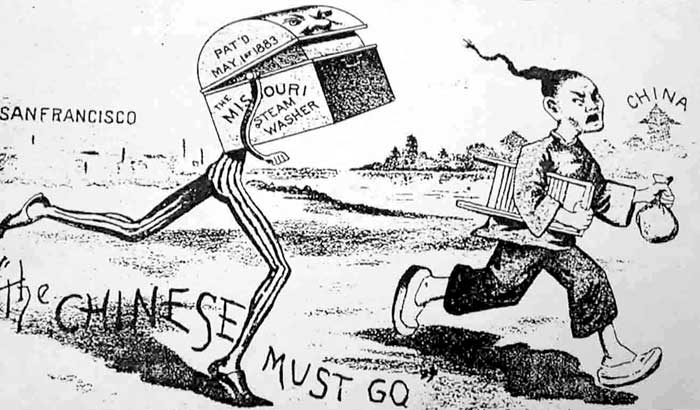
I might sound like a protectionist here, but realistically speaking, all this hollering about Chinese stealing American jobs not only echos the same from more than two centuries ago in the 1800’s:

chinese must go ce_witness_2_lg

The Japanese doesn’t even bother stealing American’s Jobs, they just put a plant in America, make Americans work to build the cars and then take the money. I mean, Capitalist or not, as a sane person, that economical enslavement and thorough humiliation hurts more than a fucking Chinese kid working for a mouthful of food. Those fat Japanese (economic) imperialists pigs haven’t changed a bit in their ways since the last time they tried to take over the world through racial and ethnic cleansing of Asia. AND they are doing it from right under our eyes under the guise of being a better race: The advertised facts seem to say that only under Japanese management can cars be made with high quality in America. Are you going to take this crap sitting down?


Somewhat racist comments aside. I will bet you one thousand 2013 dollars that America will be richer and will have higher quality of life if we made our own cars and keep the money instead of giving it to a Japanese.

America will be richer and have better quality of life if all of China was to sink into the ocean, but the improvement will not be any where nearly as drastic as having one–just one–god damned car maker do a good job. Think of the morale boost it will give us. Who cares about the stinking iPad when I can drive, without polluting the environment, and safely and have the money go to a fellow American’s hand.


And the hidden agenda here, btw, if you are wondering about this rambling Chinese American, is to perpetuate the American way of life–life, liberty and the pursuit of happiness.


Why don’t we build a better car! Build a better car and show the world that we can do it. All of that negativity: corruption in government, large corporations, wall street… All those foreclosures, broken credit reports and all those mass killings… We will have lifted ourselves out of this freaking rut and resume our dreams of prosperity marching towards the great manifest destiny of the American way.


That would be so great!


Disclaimers: I work for a Japanese owned company. My statements here do not reflect my company’s policies. I suspect but do not know for a fact that Japan is building military robots using your hard-earned cash. I am not saying that America treat Chinese people the way they treat us in the 1800’s. I do not know the author of either books and have never read them.

The problem with Transitivity

Transitive Action Space is fairly concise space containing all those actions that are divalent. These actions are the first class of actions that we consider because it occurs most frequent in interpersonal relationships. Also because the Golden Rule and Silver Rule of ethics both syntactically refer to precisely this class of actions.

Linguists have long thought of this issue and discuss the concept of valency of verbs. monovalent verbs are intransitive, transitive verbs are divalent… Other verbs are more expressive and some has multiple valencies: do and have both can be monovalent, divalent and trivalent.

The example given in wikipedia is the following American southerner statement:

I am having myself some dinner.

“I”, “myself” and “dinner” are the parameters of “have”, which in this case is trivalent.

The interesting fact about this is that the first two np’s associated with this verb are covariant (vaguely speaking). And by this I mean

He is having himself some dinner.

She is having herself some dinner.

They are having themselves some dinner.

and so on and so forth. The first two vary together. I can never have, for example

I am having themselves some dinner…

it just wouldn’t make any sense.

We should let this sink in a second. First of all there are multivalent verbs beyond transitive verbs. Second of all, some verbs may have restriction on them regarding some or all of their np’s when used in an actual sentence.

do is the other multivalent verb.

I am doing myself a favor.

Again trivalent, however in this case covariant np’s are not required.

I am doing him a favor.

I am doing her a favor.

I am doing them a favor.

etc.

In fact, not to be vulgar but these are the things that came to mind as I think about this:

I am shitting myself a bucket of golden coins.

I am making myself a bucket of golden coins.

I am shaking myself a headache.

I am driving him nuts.

I am driving him home.

ahha, so we have a pattern. These are still transitive verbs, but their third np parameterizes the content of the action or indicate a byproduct of the action.

I can shit you a bucket of gold.

To me, you the object of the action, the receiver and gold is the content of the action. I am straining but not seeing my doing anything to gold using you. similar pattern apply to the other of the previous sentences.

I’d like to include these trivalent verbs in the transitive action space by adding the additional noun phrase into the verb forming verb-np super-verbs that can be applied to the parameters of previously defined Transitive Action Space (i.e. you and me).

(shitting gold)

(making gold coin)

(shaking (out) a headache)

(driving nuts)

(driving home)

are included as trivalent transitive actions.

EMR errors and Privacy

EMR and Troubles with Identity Privacy

So recently I received a bill from an out of the state medical clinic. The bill charges me with treatment that were obviously not rendered unto me. The bill contained my name and physical address.

I called them and they very quickly rescinded the bill.

However, there is one remaining issue, which is that the US has promoted Electronic Medical Records (EMR) system. In fact, it appears that there might even be a mandatory EMR system in the near future. Consider for a minute that such a thing happened when mandatory EMR system is in force. What would happen?

I may be rejected for health insurance on the basis of pre-existing condition based on treatment a hospital claim to have rendered. Is this possible? Well, I have a bill here from an out-of-state clinic that says YES they can make mistake like that and can affect my permanent medical record.

Mandatory EMR/EHR is a godsend for insurance companies. It means they can receive the full history of a person’s past and perform sophisticated risk analysis that produce premium rates according to the person’s risk for illness or injury.

One would react to a  $25 insurance premium by not buying insurance and react to a $5,000,000 premium by committing suicide. Because if it is entirely based on risk and incidence prediction a $25 bill means that insurance company expects to pay that or less for your treatment, and similarly a five million dollar bill would mean there are significant evidence that I will need to pay that much to live.

I had written a bit about how this company found my address and put me down for the bill, but I realize that by talking about it, I am letting the world know how that company found my personal address, and I don’t want that, so let us not talk about the privacy problems here and move on to a larger issue:

The problem it could cause for us when an error is made is that our permanent record will be marred forever. I hate telling horror stories but let me tell this one:

4 months ago I leased my new 2013 Chevy Volt. California has a law that allows drivers of these environmentally friendly cars to drive in HOV lane using a “GREEN STICKER” which the DMV must issue. This is one of the main incentives that moved me to lease this car.

Needless to say it has been 4 months and I have not received the sticker to drive in the HOV lane. After two(3) series of phone calls and four(4) form submissions, I found out finally that my registration address had a problem from the start when I leased it from Boardwalk Chevy. I had a horrible experience leasing this car from them, being forced to sit through negotiation on a national wide promotional program with my eight-month(8) pregnant wife; being forced to sign contract three(3) times with numerous line items changing without due notice to me; the contract requiring me to pay upfront for 9 oil changes that must be used in 3 years(ON A FUCKING PLUGIN HYBRID that will not be burning gas most of the time); and then, after all that, having the wrong address entered into the computer so I cannot receive my green sticker.

But that is besides my current point, which is that there is a lot of racism and hatred and unkindness and merciless greed in this world added on top of legitimate human error and the Devil Satan. I do not believe we, as a species, have overcome these hurdles sufficiently to instrument an EMR system that will be central to our medical treatment.

If the address is wrong in my EMR, and I don’t receive prescription or communication from the doctor, it could be a matter of life or death. I mean, having to sit in traffic for an extra 60 minutes every day is a matter of wasted life, but at least it is not something that caused the complete cessation of life as an EMR error of this sorts could cause.

I am against universal mandatory EMR in the United States any time this decade.