The problem with Transitivity II–Unfixing Trivalency

Looking at my old blog entries, I think there is a problem with our earlier attempt at addressing tri-transitivity and higher order valences. The problem actually points to a larger issue. Let us try an extended example of trivalency

I am giving you a slave named Tom.

Subject: I

Object: you

Object being done with: A slave named Tom

Thinking of ethical issues: My giving a slave may be considered wrong and you allowing a slave to be given to you my be considered immoral. But ultimately, that Tom is a slave is perhaps something not ethical in and of himself. What about

I am giving you a slave named Tom to keep you alive from being quadriplegic and demented.

This seem to make me a good person and give you just cause to require full time service of a devoted person. Is this act allowable? I would if I followed Jesus’s way, and I could if I followed Confucian way.

What about the veil of innocence, how come it isn’t compatible here? at first glance, it seems that it should, what if you were Tom and you were being given. You would then choose not to give tom as slave right? But in Bi-transitive Action Space, let’s call it BTAS for short, we have no way of evaluating that, you are either subject or object, there is no third position.

The reasoning here, therefore, must extend analysis of Tri-Transitive Action Space, TTAS, and other higher valencies, HTAS’s,  to analyze the TAS itself for inclusion and usage of ethical entities that are considered of same importance as the subject and objects of TAS analysis.

* Giving a person as slave is unethical.

* Using a person as a slave is unethical.

* Being used as a slave is unethical.

The first two come from a traditional ethical systems. One cannot use another ethical entity in a subjugated manor, and one should not force an ethical entity into such a position. But what about the third, that seems a little stranger, allowing oneself to be enslaved is an unethical act. Certainly an ethical entity may be able to enslave another and should do that instead of being enslaved. Alas, these problems are indeed at the heart of concerns driving these current carpal tunnel stiffened hands into worse states than they are in already. At least, our action space needs to give us the ability to consider the third ethical entity.

Let us be more specific about BTAS as well, it is really very easy to include HTAS inside BTAS. So we need a class of TAS that include exclusively Bi-transitive verbs where the verb themselves do not use or influence any other entities affecting ethical value. This class of actions we shall refer to as Full-Bi-Transitive Action Space, or FBTAS(ef-bee-taz) for short. And similarly FTTAS for tri-transitive verbs with clearly distinguishable subject, object, and third thing which the action uses and affects evaluations of ethical nature.

I fear soon we will run out of letters and theory synonyms as we look into this matter deeply. I am driven to think of another way to think about this issue… Naming a new space for different situations is too troublesome and impractical.

IG and the Quantification of Privacy

A while back, I talked about computing IG–information gain–by clandestine methods via an otherwise secret(personal) email. I will point to some other prior blogs entries about what can we reasonably consider private and some reasons why I think it’s bad (Because it removes competition….

The basic challenge is this: If your competitor can spy on what you do (unilaterally) then they will never be motivated to innovate. Their key strength will be their ability to hack your secrets and they will work hard on that, but not on how to build a better product or cure a disease or solve a new problem. If you can both spy on each other with perfect information then there is no need to innovate, just calculate the equilibrium and aim for that. If you can disinform your opponent then all your effort will go into disinformation instead of innovation. Basically it is much easier to do something sneaky and cheat than to do the right thing and innovate. This is why the government, a non-competing body whose interest is to make sure everyone compete (at least in America government this is the case), should provide for information security.

)

I realize in retrospect that IG may not make sense to most people based on the formulation I laid out. Let’s review. IG is the change in entropy from a state without additional knowledge to a state with knowledge

IG = H(secret) – H(secret | private email)

This measurement seem to be of a quite abstract concept of entropy–a unitless measurement. Why would I think this useful for any reason other than that it is called “Information Gain?” Well truth be told, what I had in mind was more of the IG from machine learning literature: Class purity after conditioning on some private information. It is actually used more as a measurement of correctness of predicting discrete output than abstract change in entropy of distribution after conditioning. I will refer reader to these excellent introductory books regarding “classification” algorithms.

… Some days passes and the books will hopefully have arrived on your desks…

So the example is if my secret is the probability that I will have Chinese food tonight. Let’s throw in several more classes, say Italian, Mexican cover 99.9% of all possibilities. This probability may be internal to me. Or it may be an externalizable model like I will toss a three-sided die and figure out what I will eat tonight.

Actually, this system forces us to think of a new class. I will call this new class the innovation class. It covers all cases where something new might happen, such as tonight when I went off on a tangent and forgot to eat dinner completely. Or I might be abducted by Aliens for demanding privacy, Japanese paramilitary for blogging, or God for thinking all these awful things. The fact is, I do not know what will happen, but what I do know is that things I don’t know will happen. So the class is called IC, Innovation Class–now we have a 4 sided die: Chinese, Mexican, Italian, IC; Let’s write naively that the probability for each class is:

Chinese Mexican Italian IC
33% 33% 33% 1%

The formula for the entropy of these classes is written as:

-H(Dinner)= p(Chinese) * log(p(Chinese)) + p(Mexican) * log(p(Mexican)) + p(Italian) * log(p(Italian)) + p(IC)*log(p(IC))

the above evaluates to almost the maximum possible entropy in three-class situation: H(Dinner)= 1.6499060116098556

that’s it. that’s the formula for calculating entropy that we will use repeatedly. Now, suppose that you have read my email to my wife saying “oh man, look at this great deal on groupon, 50% off on Indian food right near our home” What is the right thing to think about the distribution of my dinner?

P(IC)=99%

Indian food is not Chinese or Mexican or Italian, but we have thought of that and put in IC to account for it.

Chinese Mexican Italian IC
10% 10% 10% 70%

-H(Dinner|private email to wife) = p(Chinese|private email to wife) * log(p(Chinese|private email to wife)) + p(Mexican|private email to wife) * log(p(Mexican|private email to wife)) + p(Italian|private email to wife) * log(p(Italian|private email to wife)) + p(IC|private email to wife)*log(p(IC|private email to wife))

gives us the conditional entropy of probability of dinner after reading my private email. This entropy H(Dinner|private email to wife)=0.09596342477405478

IG(Dinner; private email to wife) = H(Dinner) – H(Dinner|private email to wife) = 1.6499060116098556-0.09596342477405478=1.5539425868358008. This corresponds to an IGR of 1619.31%, that is, 15X more information after you saw the email than before.


Great! so now we know how much information is gained by reading that one private email of mine. This number, I think quantifies my loss of privacy.


Btw, this innocent example contain some hand waving. H(Dinner) for example is something that we may or may not know. Most people have trouble writing down a distribution for dinner choices. also, P(Dinner|private email to wife) here written as a table contain assumed values. What if after reading my private email you feel that P(IC)=85%? Who is to say what the reality of this probability is? This is why I felt that this model will not make to main stream legal system because the link between private email and the actual secret itself is not so obvious. You might use naive Bayes as the definitive of reality (refer to chapter in books or wiki), logistic regression, decision trees, or you might use something else… You may even use a distributions system like SVM or god forbid rule based systems…

If you understand this computation above, then it will be easy for you to understand the continuous version. Let dinner be a continuous variable, we can still write the same expression

IG(Dinner; private email to wife) = H(Dinner) – H(Dinner|private email to wife)

and it would have the same meaning. How far are we from the truth. This idea, btw, is indeed partially inspired by the name Information Gain, which also goes by Kullback-Leibler divergence when computed over distributions. The above formation exactly with the exception that “private email to wife” is a distribution, say, perhaps, my emails are generated randomly.

KL( Dinner|private email || Dinner )

But KL divergence does point us to some other interesting characterizations. Divergence–distance without some properties of distance. Namely that it is not a metric distance:

* Nonnegative dl(x,y)>=0:  yes

* Indiscernability: dl(x,y)=0 iff x==y: yes

* Symmetric dl(x,y)==dl(y,x): NO

* Triangle inequality dl(x,y)+dl(y,z) >= dl(x,z): NO

This has some serious implications regarding this formulation of privacy. Somethings that we naturally think should make sense do not.

Let’s say I have two emails, e1 and e2, and let’s say dinner is still the subject of intense TLA investigation:

KL(d;e1) + KL(d;e2) != KL(d;e1,e2)

All private information must be considered together, because considering them separately would yield inconsistent measurement of privacy loss

Let’s say there’re two secrets, d1 is my dinner choose and d2 is my wife’s dinner choose

KL(d1;e1,e2) + KL(d2;e1,e2) != KL(d1,d2; e1,e2)

All secrets must be computed together, because computing IG separately and adding is not equal to the total information gain.

Let’s say we have an intermediate decision called Mode of Transportation (mt), and it is a secret just like my dinner choice.

KL(mt;e1,e2) + KL(d ; mt) != KL(d; e1,e 2)

The intermediate secret can be calculated, but again, it must be calculated carefully and not by additive increase of IG.

Bummer, but fascinating!! But we we must make some choice about how to proceed. Knowledge about the nature of information (and especially electronic information), I believe, informs us about how we make choice in our privacy laws:


  • Should the whole data be analyzed all at once?
  • or should we only allow each individual’s data be processed all at once?
  • or should we only allow daily data of everyone to be processed together?
  • or should we only allow daily data  of each individual to be processed separately?

Each of these choice (and many other) impact the private information loss due to clandestine activities.


For Richer and for Poorer

The title makes no reference to marriage, per say. Bear with me here for a sec…

A certain strange set of circumstances inspires this thought. Some time ago, some entrepreneurial friends recommends a series of books to me, How to Win Friends and Influence people and Rich Dad, Poor Dad. Saying that these are must read for a young person planning to have a good life.


And I’ve never read either, btw, I’m guessing it really shows, huh?


Okay, okay, please stay calm when I say this, and hopefully you find it funny and non-offensive, as I don’t want my tires punctured again by a nail gun.


Has anybody thought about the psychology of Rich Dad and Poor Dad? I mean com’on, isn’t it obvious that the Japanese author wrote this subconsciously thinking of two real entities?


well? do you see it? The Japanese American author, what did he think while he wrote this? What is the driving thought?


Okay, okay, here it is. America is the Rich dad to Japan and China is the Poor dad.


oh fuck, I can hear all four tires exploding on my car…


okay, yes, yes, I am of Chinese lineage, it’s probably not PC for me to think like this, but if I were Japanese, or had Japanese wife, or if I was dating a Japanese women, it would make it all better, right?. ugh, I promise, when I am rich enough I will adopt a Japanese child, to try to make up for this trespass.


ehem, okay, so I am Chinese ethnically. And I am taught and think that Japan’s language, religion, gene pool, etc, that they in noticeable part come from China some time long long ago. I hope most reasonable people with a bit of rational unbiased inquiry will not object to my thinking this: that China can be considered a dad.


America the rich dad. Right, what makes it the rich daddy?


Here is the reasoning: I see two very large Japanese companies, Toyota, Honda,Mazda, Nissan, dominates the US automobile industry by selling to US consumers more than 50% of cars that they buy. So, that number, fifty-some percent, is more than US and European makers’ sales added up together. Certainly I will not be the first to say that “Japanese cars last longer than American cars” is common wisdom among value car shoppers.


Now, I’d like to consider myself a hard-working American. I am American, born in China but naturalized. I feel that my upbringing, growing up in the China of 1980s, and America of 1990’s that I deeply believe in the values that America was built upon. I feel that it is right that I should support this country by working hard, contributing to its production. I recently begun to drive to work everyday and have begun to appreciate the importance of a reliable car when work demands that I get there everyday.


As a hard-working American needing a reliable car, I can tell you that in large investments such as a car for a hard-working American, reliability is important. And if it is Japanese car company that we need to go to find reliability, then we will do that, because we want to work and getting to work is important.


BUT, would you not agree that you’d rather be driving an American car to work than a Japanese car? As a person working and producing in America, would you not feel happier if you heard somebody say: “American cars are Better than Japanese cars” ? More reliable, better fuel mileage, higher safety standards. Would that not bring a grin to your face like it would to mine? I will not belabor this point, but I fear that many Americans have not had a chance to stop and think this thought… no no, feel that thought:


“American cars are better than Japanese cars.”


Do not let the media brain wash you into thinking that Japanese cars is always better than American cars, or that it is necessary for another reason. You, American, you can dance, you can sing, you can build a better car than the Japanese.


Why is this so important? Because I feel that sometimes, people here do not get the freedom of mind to think these thoughts. It is not racist to want to build a better American car. It is not politically incorrect. In fact, it really should be less politically incorrect than for the mass media to try to steal the shirts off of those poor Chinese children’s back as they try to make wage to feed themselves and perhaps their family.


Let me repeat! This is not racist! This is national competition. When an honest working American hands out the cash that he honestly made to a Toyota dealer for a car, and I don’t care of the sleazy sales guy is American and his boss is American and his boss is American and the whole company falls under an American registered corporation. The owner of that company (stock owners, board, etc.) are Japanese people. Check on Google or Yahoo or Bing finance, the board of these American companies are completely occupied by people with Japanese names. Yes, some of them may be American citizens, but they all have Japanese names, they are all Japanese people. I don’t need to perform a statistical test to say that that’s not a representative sample of American business man. The companies are completely controlled by Japan.


When you hand over your hard-earned greenbacks to Toyota or Honda, or Nissan or Mazda for a “higher quality car” you are putting that money in the hands of a Japanese person. He is not an American Citizen, he is not concerned about the perpetuation and propagation of the American way. He is a Japanese person who has his own national and racial interests and agendas that differ, perhaps greatly, from those of American interest and values. When you hand your money to him, he has free will to use that money in ways that do not align with American values.


God!! Japan couldn’t send a single radio-activity resistant robot into their power plant to fix the leaks and had to wait for American robots to check out the power plant? I do not believe this, and you shouldn’t either. For all we know, (and we do know at least Honda is doing significant research in non-automotive robotics) that the robot that kills you in World War III is being designed right now! Using your hard-earned money! right now! in Japan! Right at this moment!


This really needn’t be said, but for some reason I feel this needed to be pointed out: when you buy a Japanese car, you implicitly support Japanese value system and if their values are racist or imperialistic, you have no say over if he can spend money-making weapons or take over the world. You have no say in their attempt to sabotage a great American company like Boeing with their defective batteries. (And making it look like America cannot engineer a good plane.)


When you hand the money over, it is theirs and they can spend it how they want.


True, when you buy from England, Germany, France, Russia, Brazil, India or Chinese, you hand them money so they can spend it the way they want, but I find it very hard to believe that we find Japanese culture and policies, in the long-term, to be more American than all of America, German, Europa, Asia, etc, combined.


In Capitalist world, money speaks, and the money is speaking Japanese right now.


America, the rich sugar daddy, and China the poor chopstick daddy.


America, the rich sugar daddy at cost to it’s lower/middle class people who have to have dependable cars to go to work. They are being forced to hand money to Japanese company due to the lack of dependable American cars.


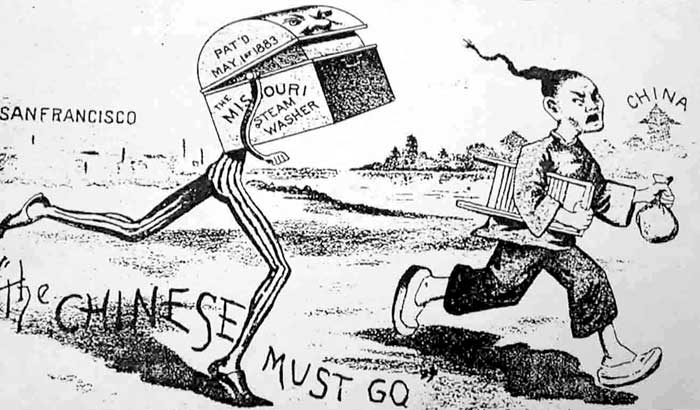
I might sound like a protectionist here, but realistically speaking, all this hollering about Chinese stealing American jobs not only echos the same from more than two centuries ago in the 1800’s:

chinese must go ce_witness_2_lg

The Japanese doesn’t even bother stealing American’s Jobs, they just put a plant in America, make Americans work to build the cars and then take the money. I mean, Capitalist or not, as a sane person, that economical enslavement and thorough humiliation hurts more than a fucking Chinese kid working for a mouthful of food. Those fat Japanese (economic) imperialists pigs haven’t changed a bit in their ways since the last time they tried to take over the world through racial and ethnic cleansing of Asia. AND they are doing it from right under our eyes under the guise of being a better race: The advertised facts seem to say that only under Japanese management can cars be made with high quality in America. Are you going to take this crap sitting down?


Somewhat racist comments aside. I will bet you one thousand 2013 dollars that America will be richer and will have higher quality of life if we made our own cars and keep the money instead of giving it to a Japanese.

America will be richer and have better quality of life if all of China was to sink into the ocean, but the improvement will not be any where nearly as drastic as having one–just one–god damned car maker do a good job. Think of the morale boost it will give us. Who cares about the stinking iPad when I can drive, without polluting the environment, and safely and have the money go to a fellow American’s hand.


And the hidden agenda here, btw, if you are wondering about this rambling Chinese American, is to perpetuate the American way of life–life, liberty and the pursuit of happiness.


Why don’t we build a better car! Build a better car and show the world that we can do it. All of that negativity: corruption in government, large corporations, wall street… All those foreclosures, broken credit reports and all those mass killings… We will have lifted ourselves out of this freaking rut and resume our dreams of prosperity marching towards the great manifest destiny of the American way.


That would be so great!


Disclaimers: I work for a Japanese owned company. My statements here do not reflect my company’s policies. I suspect but do not know for a fact that Japan is building military robots using your hard-earned cash. I am not saying that America treat Chinese people the way they treat us in the 1800’s. I do not know the author of either books and have never read them.
The problem with Transitivity

Transitive Action Space is fairly concise space containing all those actions that are divalent. These actions are the first class of actions that we consider because it occurs most frequent in interpersonal relationships. Also because the Golden Rule and Silver Rule of ethics both syntactically refer to precisely this class of actions.

Linguists have long thought of this issue and discuss the concept of valency of verbs. monovalent verbs are intransitive, transitive verbs are divalent… Other verbs are more expressive and some has multiple valencies: do and have both can be monovalent, divalent and trivalent.

The example given in wikipedia is the following American southerner statement:

I am having myself some dinner.

“I”, “myself” and “dinner” are the parameters of “have”, which in this case is trivalent.

The interesting fact about this is that the first two np’s associated with this verb are covariant (vaguely speaking). And by this I mean

He is having himself some dinner.

She is having herself some dinner.

They are having themselves some dinner.

and so on and so forth. The first two vary together. I can never have, for example

I am having themselves some dinner…

it just wouldn’t make any sense.

We should let this sink in a second. First of all there are multivalent verbs beyond transitive verbs. Second of all, some verbs may have restriction on them regarding some or all of their np’s when used in an actual sentence.

do is the other multivalent verb.

I am doing myself a favor.

Again trivalent, however in this case covariant np’s are not required.

I am doing him a favor.

I am doing her a favor.

I am doing them a favor.

etc.

In fact, not to be vulgar but these are the things that came to mind as I think about this:

I am shitting myself a bucket of golden coins.

I am making myself a bucket of golden coins.

I am shaking myself a headache.

I am driving him nuts.

I am driving him home.

ahha, so we have a pattern. These are still transitive verbs, but their third np parameterizes the content of the action or indicate a byproduct of the action.

I can shit you a bucket of gold.

To me, you the object of the action, the receiver and gold is the content of the action. I am straining but not seeing my doing anything to gold using you. similar pattern apply to the other of the previous sentences.

I’d like to include these trivalent verbs in the transitive action space by adding the additional noun phrase into the verb forming verb-np super-verbs that can be applied to the parameters of previously defined Transitive Action Space (i.e. you and me).

(shitting gold)

(making gold coin)

(shaking (out) a headache)

(driving nuts)

(driving home)

are included as trivalent transitive actions.

EMR errors and Privacy

EMR and Troubles with Identity Privacy

So recently I received a bill from an out of the state medical clinic. The bill charges me with treatment that were obviously not rendered unto me. The bill contained my name and physical address.

I called them and they very quickly rescinded the bill.

However, there is one remaining issue, which is that the US has promoted Electronic Medical Records (EMR) system. In fact, it appears that there might even be a mandatory EMR system in the near future. Consider for a minute that such a thing happened when mandatory EMR system is in force. What would happen?

I may be rejected for health insurance on the basis of pre-existing condition based on treatment a hospital claim to have rendered. Is this possible? Well, I have a bill here from an out-of-state clinic that says YES they can make mistake like that and can affect my permanent medical record.

Mandatory EMR/EHR is a godsend for insurance companies. It means they can receive the full history of a person’s past and perform sophisticated risk analysis that produce premium rates according to the person’s risk for illness or injury.

One would react to a  $25 insurance premium by not buying insurance and react to a $5,000,000 premium by committing suicide. Because if it is entirely based on risk and incidence prediction a $25 bill means that insurance company expects to pay that or less for your treatment, and similarly a five million dollar bill would mean there are significant evidence that I will need to pay that much to live.

I had written a bit about how this company found my address and put me down for the bill, but I realize that by talking about it, I am letting the world know how that company found my personal address, and I don’t want that, so let us not talk about the privacy problems here and move on to a larger issue:

The problem it could cause for us when an error is made is that our permanent record will be marred forever. I hate telling horror stories but let me tell this one:

4 months ago I leased my new 2013 Chevy Volt. California has a law that allows drivers of these environmentally friendly cars to drive in HOV lane using a “GREEN STICKER” which the DMV must issue. This is one of the main incentives that moved me to lease this car.

Needless to say it has been 4 months and I have not received the sticker to drive in the HOV lane. After two(3) series of phone calls and four(4) form submissions, I found out finally that my registration address had a problem from the start when I leased it from Boardwalk Chevy. I had a horrible experience leasing this car from them, being forced to sit through negotiation on a national wide promotional program with my eight-month(8) pregnant wife; being forced to sign contract three(3) times with numerous line items changing without due notice to me; the contract requiring me to pay upfront for 9 oil changes that must be used in 3 years(ON A FUCKING PLUGIN HYBRID that will not be burning gas most of the time); and then, after all that, having the wrong address entered into the computer so I cannot receive my green sticker.

But that is besides my current point, which is that there is a lot of racism and hatred and unkindness and merciless greed in this world added on top of legitimate human error and the Devil Satan. I do not believe we, as a species, have overcome these hurdles sufficiently to instrument an EMR system that will be central to our medical treatment.

If the address is wrong in my EMR, and I don’t receive prescription or communication from the doctor, it could be a matter of life or death. I mean, having to sit in traffic for an extra 60 minutes every day is a matter of wasted life, but at least it is not something that caused the complete cessation of life as an EMR error of this sorts could cause.

I am against universal mandatory EMR in the United States any time this decade.

Activities of a Clandestine Nature (4 of…

Recently I heard a really great argument against clandestine activities: It perpetuates the practice, the habits, the policies, and the systems that facilitate clandestine activities. Being something that we don’t want, systematic clandestine activities should be pointed out, certainly be strictly live-audited by unbiased third parties.

Why is clandestine activities bad? The truth of the matter is that knowledge begotten of clandestine activities are inherently out of context and incomplete information. Why spy on my computer, when you can walk up to me and ask? When you take a small slice of what happens, you will surely miss the whole as the whole is not represented by some of the things that you are able to see as a clandestine agent.

Previously suggested problem that those taking part in clandestine activities will as all things in nature fall into the path of least resistance. Some day, we will just water board every person we suspect, I mean why not? I’m sure there’s an email I sent once that says “I hate you” or “I’m gonna kill you” or “I hope you die”. And my constant opposition of clandestine activities is surely sign that I plan something and desire that no one sees it.

What is the difference between these series acts: passing a secret law that permits some person unknown to me at a time unknown to me read my emails, gather all my past school and employment records, find copies of all emails I’ve ever sent by USPS, and analyze all information about all my past employment and my family and friends, and these second series of acts: passing a secret law that permits some person unknown to me at a time unknown to me knock me out (perhaps it’s already happening in my sleep ? or even on flights, god knows how often I fall asleep quite inexplicably moments before push-off, with two air jets blowing cold air at me and two reading lights shining down! and only to come to quite suddenly for no reason), and torture me and get that information?

Well, you say, there is collateral damage, you feel pain when you are tortured but you do not feel pain when your email is being scanned. This ought to be the most humane way of getting the information from you. Why are you not on your knees thanking all the people whose hard work went into making it so that you are not water boarded? (rightfully or not)

Aha, thank you President Obama! The constitution should save us… Let’s see, according to wiki it implicitly presumes innocent for US citizens until proven guilty, but it provides wide leeway for authorities to investigate when suspicion is arouse.

We cannot pursue it through cruel and unusual punishments(8th amendment) as reading my email can hardly be construed as cruel and unusual… even in my interpretation. Although I can imagine some feel it is cruel.

It appears in the Fourth Amendment against unreasonable search and seizure:

The right of the people to be secure in their persons, houses, papers, and effects, against unreasonable searches and seizures, shall not be violated, and no Warrants shall issue, but upon probable cause, supported by Oath or affirmation, and particularly describing the place to be searched, and the persons or things to be seized.

It also fall under Fifth Amendment of due process:

No person shall be held to answer for a capital, or otherwise infamous crime, unless on a presentment or indictment of a Grand Jury, except in cases arising in the land or naval forces, or in the Militia, when in actual service in time of War or public danger; nor shall any person be subject for the same offence to be twice put in jeopardy of life or limb; nor shall be compelled in any criminal case to be a witness against himself, nor be deprived of life, liberty, or property, without due process of law; nor shall private property be taken for public use, without just compensation.

There should be a Grand Jury of my peers selected uniformly at random who when presented with evidence agree to the search and seizure of my information. I should not be deprived of my liberty and (privacy) property without due process of law. And of course the Ninth Amendment says that we may have rights beyond those listed

The enumeration in the Constitution, of certain rights, shall not be construed to deny or disparage others retained by the people.

I should cover my behind and say, you guys in law enforcement are doing a heck of a job, which is much appreciated by present author. And I really hate all those other people who invade my privacy. It’s just that I might have a small chance by conventional means (law suite, legal protests, policies, etc.) of changing those things you do that I don’t like, and I do not have methods to affect those others.

Everyone who do take part in clandestine activities all feel absolute righteousness as they proceed in invasion of privacy that I do not want them to. Their feeling and their intention absolutely annoys me in addition to their act of invasion. Perhaps we should define invasion of privacy more formally so that these feelings about their feelings are processed rationally. If they can define information theoretic brain death, why can we not define more precisely what invasion of privacy is? What is personal privacy beyond those facts(bits, characters, words, sentences…) whose association with me is information that may cause me harm? regardless of harm, can we take the entropy of those bits and say that is the quantity of privacy lost? Actually, we should take information gain from a representative population and that is the information I lose–those that you gain. The privacy loss as defined (the negative of your information gain by reading my email from knowledge of all emails) actually only qualifies the privacy. It actually does not quantify it sufficiently.

Sadly, this very truthful and fundamental definition takes us a short ways. If you were an English major trying to find new phrasing of something, or if you are a VC looking for new cute company names, this will definitely find information detrimental to those trying to keep it private. But if I am someone plotting next Taliban attack, or someone discussing 21st century is a Marxist century, then the naïve information loss does not help as much as you would like it to (Certainly my email would give away less information under this definition than XYXYXZZZ.com inc) If everyone writes emails using words representing their true meaning equally and every one has same amount of total information(private+public) associated with them then reading your email and reading my email decreases our privacy equally. So we have parameters I_pr for private information, I_pu for public information.

We should compute using Bayes’ rule to compute

P(I_pr|my emails, others’ emails, I_pu) =

P(my emails | I_pr,I_pu, others’ emails)*P(I_pr,I_pu, others’ emails)/P(my emails, others’ emails, I_pu)

and

P(my emails|Others’ emails, I_pu)

and we can then calculate the information

IG(I_pr; my emails|others’ emails, I_pu)

based on these distributions, pending specification of relevant linking functions or mechanisms. But the problem with this much more convincing information gain is that you will never convince anyone that the link functions is representative of you. Too complicated for constitutional purposes for sure, and the courts will surely not be empathetic enough to follow the math… Maybe next century when everyone’s played with IG and done some modeling in grammar school.

For another example the number $54,102,299.14 and the number $14,541,022.99 relieves me of the same character-wise entropy privacy, however are quantitatively different. We need to rely on some oracle magic. Suppose there is a most concise way to describe the entirety of my privacy, say H containing a series of bits an oracle produced. Your knowledge of H would be your complete knowledge about me. ergmum, we should have a vocabulary of engrams, minimal cognitive elements… H is a series of engrams that is the complete knowledge about me–it’s finiteness is not specified. Let’s also suppose that my emails (the thing that you use to access my privacy) is encoded by the same oracle using the same engram language producing E the complete knowledge about my emails. |H| is the theoretic maximum privacy I can lose, H*E is the information that I actually lost (inner product like operation for vector space, TBD for strings, perhaps LCS for a special oracle). It remains only to calculate distance(such as edit_distance(H,E) for strings and euclidian_distance(H,E) for euclidian spaces) which is disinformation you gained by reading my email. H*E/|H| is the ratio of my privacy lost, H*E/|E| is the truthfulness of my emails.

It remains to be seen how to find an oracle, the definition of the engram language, operations over it, campaign to enact law to account and compensate us for the privacy lost, etc. However, I am really really wishing that all these clandestine activities are like zits in the face of growing humanity reaching adulthood and will blow away as our vitalities settle into their respective places.

The Ninja Innovation, Golden Globe, CES, etc.

Just returned from CES and I’ve been reading Ninja Innovation written and autographed by Gary Shapiro who heads CEA which runs CES which is where I found out about the book. The book goes down like a good scotch. Which is to say it is well aged, taste great, and a little intoxicating.
Also, reading the book I found out about German strategist Carl von Clausewitz. Hehe, I couldn’t help but giggle a little regarding the “dialectic thesis and antithesis of war”… Recalling times long ago, in a land far away, where I first heard of the words “dialectics”, “thesis”, “antithesis” and the “resolution”.
UGH, on second thought, should I post about this? It will surely arouse suspicion of multiple agencies from who knows how many countries monitoring the online postings that mentions these terms. I probably just signed the United States “Wire-tap” Warrant to endlessly monitor and analyze my blog and email and all other personal things, and to retroactively obtain all records of all my private things since birth, by writing about this. Want to give a quick shout out to Jodi Foster(Congrats on being recognized for lifetime achievement at 2013 Golden Globe), I am your fan! I know I’m not a big star since age of three, but still Go Privacy!!! 🙂
hehe, okay, but do let me say, I find that today I am not so attracted to this idea of Hegel’s.

But Clausewitz’s work seem much more interesting. The expression “fog of war” started there. These things that are so obvious today, but probably rarely fully understood, very difficult to clarify in author’s own head, and much more difficult to write in language at that time: Obviously the leadership of military has personalities, and obviously those personalities greatly affect what battles are fought and who wins wars. Obviously war includes clearly distinguishable elements (in fact physically separate aspects) of “force” and “uncertainty” and that their “resolution” would rely on the “creative spirit” of those involved, (aka fascinating trinity, die wunderliche Dreifaltigkeit). It sounds so obvious and so right and needless to write–Obviously, now, that I read it’s summary in Wikipedia after more than two centuries of people reading and summarizing it) But at that time, perhaps nobody has yet fully grasped all these insights and put them together–except for Clausewitz, of course.

The same goes for Ninja Innovation, what’s said seem completely obvious: Of course you need a team of highly specialized people who wants to, are able to, and are willing to work together to, and are willing to wait until the timing is right to accomplish a common goal. But the salience with which this is pointed out through personal experience of highly complex success stories is absolutely critical for the book to be of value to readers, and Shapiro accomplishes that.
Oh, I also want to plug my own blog having similar title called “The Good Business — Ninja’s approach.” I must admit, in I originally used the word Ninja slightly derogatorily–This blog documents many of the business practices the “business ninjas” used successfully, or attempted without negative consequences, on me that are perhaps violate professional ethics. The good thing is that the blog did morph to include various devious ways for me to become a business Ninja. Great minds think alike, and we have both landed on Ninja.

I want to quote a line describing the Ninjas from Shapiro’s book, that they excel at “the art of espionage, sabotage, infiltration, and assassination” OMG, my heart stopped when I read this. This is the kind of people that the above fine print speak of. Those that spies and sabotages in complete secrecy! they infiltrate my work, hack my accounts, befriend my friends, family, and they kill. Powerful! very powerful, very insightful! exhilarating passage!

Link to the book on Amazon: Ninja Innovation: The Ten Killer Strategies of the World’s Most Successful Businesses.

Additional links on Clauswitz’s work:

p.s. note for self: center-of-gravity in these context is center of target of attack.
p.p.s. Next time I visit Vegas for fun, I’d like it to be riding California’s new high speed rails…

The Ethics Hierarchy and More Diagramming

I recently learned of the Chomsky hierarchy(aka the Chomsky–Schützenberger hierarchy). It would appear to me that what I have discovered also forms a hierarchy of various ethical maxims. Also, I should mention we have added Laozi‘s 无为 advocating minimized interference both in governance as well as personal improvements. At first glance, it seems very nice that the transitive action space for these maxims fall into proper subset relationships. But as we shall see, this naïve hierarchy only begin to illustrate the relative situation of these maxims in the world.

 Ethical Hiearchy

We have not considered the possibility that I am not able to do some things to others and others may not be able to do some things to me. Let us redraw the Ethics Hierarchy but introduce additional capability regions in the transitive action space. Oh, and we have also introduced color to enhance readability of the picture.

gold versus silver 1 Why is this interesting? Well for one thing we are at a stage where Venn diagram can actually separate all the regions that we are interested in. A second reason is that it makes us realized that the containment relationship visualization using grammar school Venn diagrams that my dad pointed me to was only just the beginning of our exploration. We can draw more circles and see that our world have distinctive sections with different shades of meaning, benefit and possibilities.

For instance, one thing this graph points out is that there are things that Confucius or Jesus recommends us to do that we cannot actually do to others.It also shows us that there are things that we desire that in reality we cannot receive, however we can perform the act onto others. The graph also points out that there are the region of actions space within our desires that others can never give to us.

Lastly from looking at this picture, it seems that actions within realm of possibility that are not recommended by the Jesus action set is small. On the other hand, the actions that Confucius recommend that are not possible is also small. From freehand drawing it would appear that the completely impossible actions inside the Confucius action set is small relative to all Confucius’s recommendations, and similarly the completely possible actions outside of the Jesus set is small compared to the whole Jesus set.

Fascinating!!!

On the sizes of average of ratios

I once asked this silly question on an interview:

Which is larger, a micro-average or a macro-average?

Not knowing the answer for many years until recently when I sat down and worked it out, in fact in a more general sense, for non-averages as well, let a,b,c,d refer to any real number with d>=b>=0.

(a+c)/(b+d) <= (a/b + c/d)/2

if

a/b >= c/d

equality holds, and inequality inverts, in both simultaneously.

okay okay, all my friends laughing at me, I know this is silly little math exercise you did when you were in a diaper… whatever!!

The impact of this is, if one is to change from one average to another average half way through some testing period, while controlling the denominator of these inequalities, one would technically not be lying when one says the average has gone up. (not stating that the definition of average has changed)

Here is the mnemonic: Smaller Smaller Smaller Bigger: Ratio with the Smaller denominator being Smaller than ratio with the larger denominator means the Smaller average is Bigger than the bigger average,

TODO: generate general case averaging n ratios.

Golden V. Silver Round II.I

Holiday season 2012, wishing everyone a happy new year. Merry Christmas.

I had a frank conversation with my father and asked him to read Round II. He felt my explanations were unclear. Instead, he drew the following picture to illustrate from my conditionalization of the ethical imperatives. It stems from his ever present grammar school math basics which says that in a set theoretic axiomatic logic system the statement

if P then Q has the following Venn Diagram:

Because Q is true exceeds the situations when P is true, but not vice versa, therefore the containment relationship. After some quick calculation, due to the inversion and making sure the relationship still matches, the golden and silver rule when put into the same “action space” produces the following Venn Diagram:

It takes a moment to convince one’s self that the smallest set “Confucius wants” fits inside what “I want”. But if you image the outside of “Confucius wants” is Q above in the negative space and outside of “I want” is P in negative space and is therefore superset to Q.

This is now indeed very clear. By visualizing the action space over which both ethical imperatives
residethose things within my ability to do to other and to be done onto–suddenly we find that these sets of actions: things I can do, things jesus wants me to do, things Confucius wants me to do, and things I want to do, have a superset relationship. The large sets are always proper super set of smaller sets unless I want done to me include all possible things or nothing.

It’s kind of surprising that Confucius silver rule recommends doing fewer things than Jesus’s golden rule–But then again, it may make sense, Confucius speaks much of humbleness, about learning from teachers, he puts greater value on meta-knowledge about one’s own knowledge than the knowledge themselves. Perhaps this conservative valuation of self prevents him from doing as much.

Jesus on the other hand, son of god, savior of the world asks follower to do more in pursuit of heaven. Let’s celebrate his birth…

Merry Christmas, everyone!